
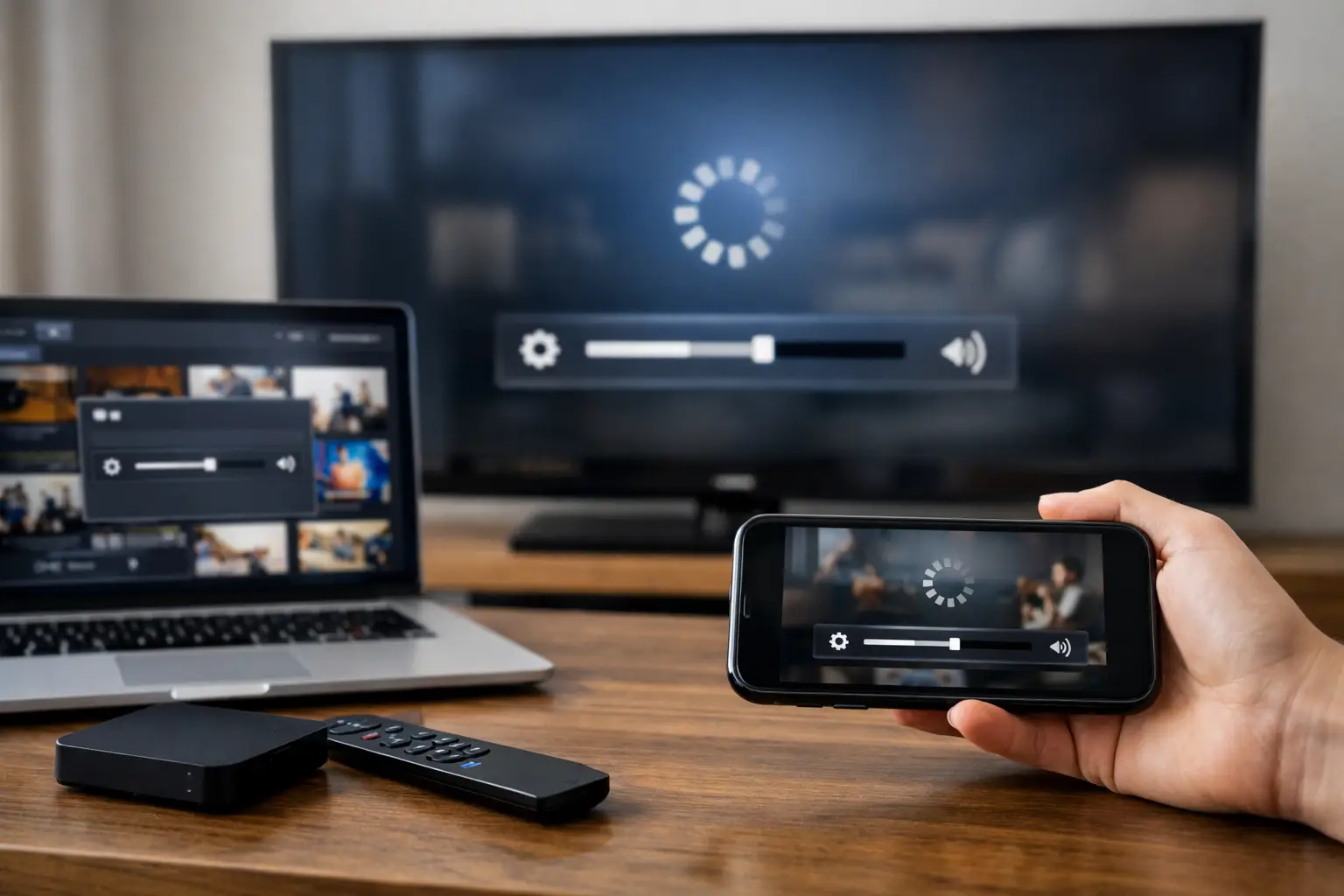
A spinning circle in the middle of a live channel is frustrating, especially when the family is ready to watch the news, a game, or a favorite Russian series. Learning how to set IPTV buffer settings can reduce interruptions, but the right setting depends on your device, player app, and internet connection. A larger buffer gives the app more video to hold before playback starts. That usually means fewer pauses, although channels may take a little longer to open.
What IPTV Buffer Settings Actually Do
IPTV buffering is a small reserve of video data stored by your player before and during playback. If your internet speed briefly drops or your home Wi-Fi gets busy, the player uses that reserve to keep the channel playing instead of stopping immediately.
Buffer settings are commonly measured in seconds, milliseconds, or megabytes. They may appear under names such as Buffer Size, Network Cache, Playback Buffer, Stream Buffer, or Cache. There is no single setting that works for every household. A phone on strong Wi-Fi may play well with a short buffer, while a Smart TV in a room far from the router may need a larger one.
A buffer is not a way to create internet speed that is not available. If a connection is consistently too slow for an HD or 4K channel, increasing the buffer may only delay the next interruption. Start by making sure your connection is stable, then adjust the player setting.
How to Set IPTV Buffer for Smoother Playback
For most viewers, begin with a moderate setting rather than choosing the maximum available value. A practical starting point is 10 to 20 seconds for live TV. Watch several channels, including higher-quality HD channels, for at least 10 minutes. If pauses continue, increase the buffer gradually to 20 to 30 seconds.
Avoid changing several settings at once. Raise the buffer, test playback, and then decide whether another change is needed. This makes it easier to identify what actually solved the problem.
A larger setting is usually helpful when your connection has occasional short interruptions, multiple people are using the same network, or you are watching through Wi-Fi. A smaller setting can be better if you want channels to start quickly and your internet connection is fast and stable. For live sports, news, and other real-time programming, remember that a very large buffer can put your stream farther behind the live broadcast.
Before You Change the Buffer
Restart the streaming device and router first. This simple step clears temporary network issues and can improve playback without changing any app settings. Also check whether another device in the home is downloading large files, gaming online, or streaming 4K video at the same time.
Whenever possible, connect a Smart TV or TV box to the router with an Ethernet cable. Wired connections are typically more stable than Wi-Fi and are especially useful for Full HD and 4K viewing. If Ethernet is not practical, use the 5 GHz Wi-Fi band when your device supports it and place the router in an open, central location.
Buffer Settings in Popular IPTV Players
The exact menu varies by app and device. Look for player, playback, advanced, network, or cache settings after opening your IPTV application.
VLC on a Computer
In VLC, network buffering is typically found in the advanced preferences under Input/Codecs. The setting may be called Network caching and is usually entered in milliseconds. A starting value of 10,000 to 20,000 milliseconds equals 10 to 20 seconds.
If a channel freezes occasionally, try 30,000 milliseconds and test again. Do not jump immediately to very high values. Excessive network caching can make channel changes slow and increase the delay on live programming.
OTT Navigator on Android and TV Boxes
OTT Navigator offers playback controls that can vary by version and device. Open the app settings and look for Player, Playback, or Buffer options. If you see a buffer value in seconds, start at 15 seconds. If the app uses milliseconds, start around 15,000.
Some Android TV boxes have limited memory or older processors. If increasing the buffer does not help, close unused apps, restart the box, and confirm that the device has enough free storage. A player cannot maintain smooth video if the device itself is overloaded.
Televizo on Android Devices
In Televizo, review the playback or player settings for cache and buffering controls. Start with a medium buffer rather than the lowest setting. Test a live HD channel after saving the change, then move up in small steps if needed.
If Televizo gives you a choice of video player, test the available options one at a time. Some devices handle one player engine better than another. Keep the player that opens channels reliably and maintains stable playback.
Smart TVs and Built-In IPTV Apps
Many Smart TV apps do not offer a manual buffer control. In that case, the most effective adjustment is often your network connection. Restart the TV, update the app if an update is available, and use wired Ethernet or stronger 5 GHz Wi-Fi.
If the app includes a setting called buffer, cache, or playback delay, use the same approach: start in the middle of the available range and test. Do not assume the highest number is best. On a TV with a stable wired connection, a large buffer may only make channel switching feel slower.
When Buffering Is Not a Buffer-Setting Problem
If every channel pauses at the same time, the issue may be your home network, internet provider, or temporary service congestion. Check whether websites and other streaming apps are also slow. If they are, adjusting the IPTV player alone is unlikely to fix the issue.
If only one or two channels have problems while the rest play normally, test those channels later. The source feed may be temporarily busy or undergoing maintenance. If the issue continues, note the channel name, time, device, and player app before contacting support. Those details help identify the cause faster.
Picture quality also matters. A 4K stream needs more consistent bandwidth than SD or standard HD. If your connection is shared among several people, selecting an HD channel instead of 4K can be the practical choice during busy evening hours. You still get a clear picture with less demand on the network.
A Simple Setup for Family Viewing
For a household using IPTV on several screens, prioritize the main television. Connect the primary Smart TV or set-top box by Ethernet if possible, keep its player buffer at about 15 to 30 seconds, and avoid running major downloads during live events. Phones and tablets can use a slightly shorter setting when they are close to the router.
Russia Plus TV is designed for viewing across compatible Smart TVs, TV boxes, phones, tablets, and computers, so the player and connection you choose make a real difference. A stable setup helps everyone enjoy live channels, archives, films, cartoons, and series without constantly adjusting settings.
When you are deciding how to set IPTV buffer, aim for the smallest setting that plays reliably on your usual channels. That gives you a responsive experience, fewer pauses, and less delay from the live program when it matters most.