

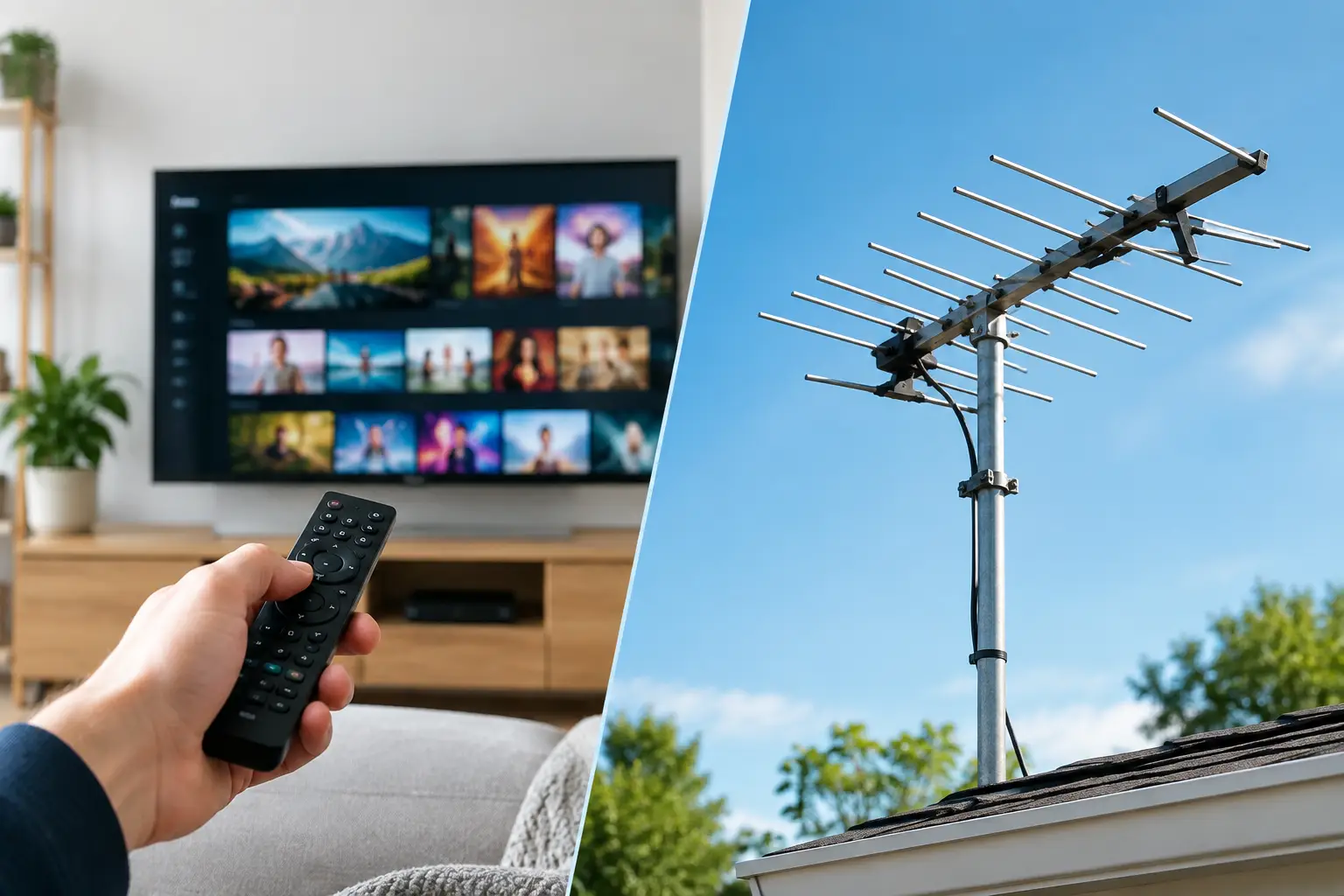
A rooftop antenna can still be useful for local news and major network broadcasts, but it cannot solve the main problem many Russian-speaking families face in the United States: finding familiar channels, language, and programming in one place. When comparing IPTV versus antenna, the better choice depends on what you watch, where you live, and whether your household needs more than a small selection of local stations.
An antenna receives over-the-air broadcasts available in your area. IPTV delivers television through an internet connection, making it possible to watch live channels, archives, and on-demand content on devices you already use. For households looking for Russian, Ukrainian, and regional entertainment alongside flexible viewing, that difference is often decisive.
IPTV versus antenna: the core difference
An antenna is a local solution. It picks up free broadcast signals sent by TV stations near your home. Channel availability varies by ZIP code, terrain, distance from transmission towers, building materials, and antenna placement. A home near a large metro area may receive dozens of channels, while another home only a few miles away may receive far fewer.
IPTV is not limited by broadcast towers. It uses your home internet connection to stream content from a subscription service. Instead of choosing only from stations transmitted nearby, viewers can access a much broader lineup, including international channels and on-demand entertainment that an antenna cannot receive.
That does not make an antenna outdated or useless. It can be a practical backup for local emergency information, network news, and live sports carried by local broadcast affiliates. But it is designed for local TV, not for a complete Russian-language family entertainment experience.
Channel choice: local broadcasts or familiar programming
The biggest advantage of an antenna is that its channels are free after the initial equipment purchase. In many parts of the US, viewers can receive major networks, public television, local news, weather, and independent stations without a monthly TV bill.
The limitation is content variety. Over-the-air television in the US is primarily built around the local market. A Russian-speaking household may find occasional international or multilingual programming in some cities, but an antenna will not typically provide a consistent selection of Russian news, films, cartoons, series, concerts, documentaries, or regional sports.
IPTV is built for broader access. A service such as Russia Plus TV offers more than 3,500 channels, along with a film library and programming for adults and children. That scale matters when different family members want different things: news and talk shows for parents, cartoons for children, movies for the evening, and live sports or entertainment on the weekend.
For viewers who mainly want ABC, CBS, NBC, PBS, or a local weather report, an antenna may cover the basics. For viewers who want regular access to Russian-language television and entertainment from across the region, IPTV is usually the more complete option.
Cost is more than the monthly price
An antenna is often described as free TV. The broadcasts themselves are free, but the setup is not always free. You may need an indoor antenna, an outdoor antenna, mounting hardware, cable, a signal amplifier, or professional installation. If reception is difficult, buying and testing multiple antennas can add cost and frustration.
IPTV has a recurring subscription cost, but it replaces the need to buy a large bundle of equipment or pay for an expensive traditional cable package. It also combines live channels with replay features and on-demand content, which can reduce the need for separate entertainment subscriptions.
The practical question is not simply, “Which option costs less?” Ask what you receive for the money. An antenna can be excellent value for a small number of local channels. An IPTV subscription may offer better value if your household would otherwise need several services to find live Russian television, movies, children’s programming, and recorded broadcasts.
Reception versus internet reliability
With an antenna, picture quality depends on signal strength. Bad weather, nearby buildings, hills, apartment walls, and indoor placement can affect reception. Digital antenna TV is often clear when the signal is strong, but when the signal drops, the picture may freeze, break up, or disappear entirely.
IPTV depends on internet quality instead. A stable home connection is especially important when several people are streaming at the same time. If your internet is slow or frequently disconnects, streaming quality may suffer. For HD, Full HD, or 4K viewing, a reliable broadband plan and a strong Wi-Fi signal are worth having.
This is an area where it truly depends on your home. A household with unreliable internet but excellent local signal reception may want to keep an antenna available. A household with dependable internet will generally find IPTV more flexible, especially when watching on several devices or in different rooms.
Device flexibility changes everyday viewing
An antenna usually connects to one television at a time. Watching it on another TV may require more wiring, a second antenna connection, or additional equipment. Taking those channels with you to a phone, tablet, or computer is not simple without a separate tuner setup.
IPTV is designed for the way people watch now. You can use a Smart TV, TV box, smartphone, tablet, computer, or compatible player. This is useful for families: one person can watch a live channel in the living room while someone else watches a film on a tablet or catches up on a program from another room.
For many immigrants and expatriate families, this flexibility has a personal benefit as well as a technical one. Familiar language and programming do not have to stay tied to a single TV in the house. They can be available during a break at work, while traveling, or when family members are watching on their own schedules.
Replay and archives are where IPTV pulls ahead
Traditional antenna TV is live television. If you miss a program, you may need to wait for a repeat broadcast, find it on another service, or use a separate recording device. A DVR can help, but it adds equipment, storage limits, and setup time.
IPTV services can include channel archives and time-shifted viewing. That means a program does not have to be watched at the exact moment it airs. If a movie starts while you are driving home, or a child has an activity during a favorite show, you can often watch later rather than miss it.
This feature is especially useful when watching channels from different time zones. A live program scheduled for the evening in another country may air during a workday in the US. Archives make the schedule more convenient for your household instead of forcing your household to follow the broadcast clock.
Picture quality and content expectations
Both options can provide high-quality video, but they do so differently. Antennas can deliver sharp HD broadcasts when reception is strong. They are a good choice for local network programming and events available over the air.
IPTV quality depends on the service, the channel source, your device, and your internet connection. With the right setup, viewers can access HD, Full HD, 4K, and even selected 3D content. More importantly, IPTV gives viewers a choice of content that local broadcasts cannot match.
Before subscribing, make sure your preferred device supports the service or an m3u8-compatible player if needed. If you use a Smart TV or TV box, check your home Wi-Fi coverage near the television. A simple adjustment, such as moving the router or using a wired connection where possible, can improve streaming stability.
When an antenna still makes sense
Choosing IPTV does not mean you have to throw away an antenna. Keeping both can be a practical arrangement. Use the antenna for local channels, emergency updates, and broadcasts available in your city. Use IPTV for the wider Russian-language lineup, replay, movies, series, and multi-device viewing your family wants.
An antenna alone makes the most sense for viewers with a very limited budget who only need local US channels and have strong reception. It is also useful in locations where internet service is unavailable or inconsistent. In nearly every other situation, its limited channel selection becomes clear quickly.
For Russian-speaking households that want more than local television, IPTV provides the everyday convenience that an antenna cannot offer. Choose the setup that fits your internet connection, devices, and viewing habits, then make sure every member of the family can easily find something familiar to watch.