

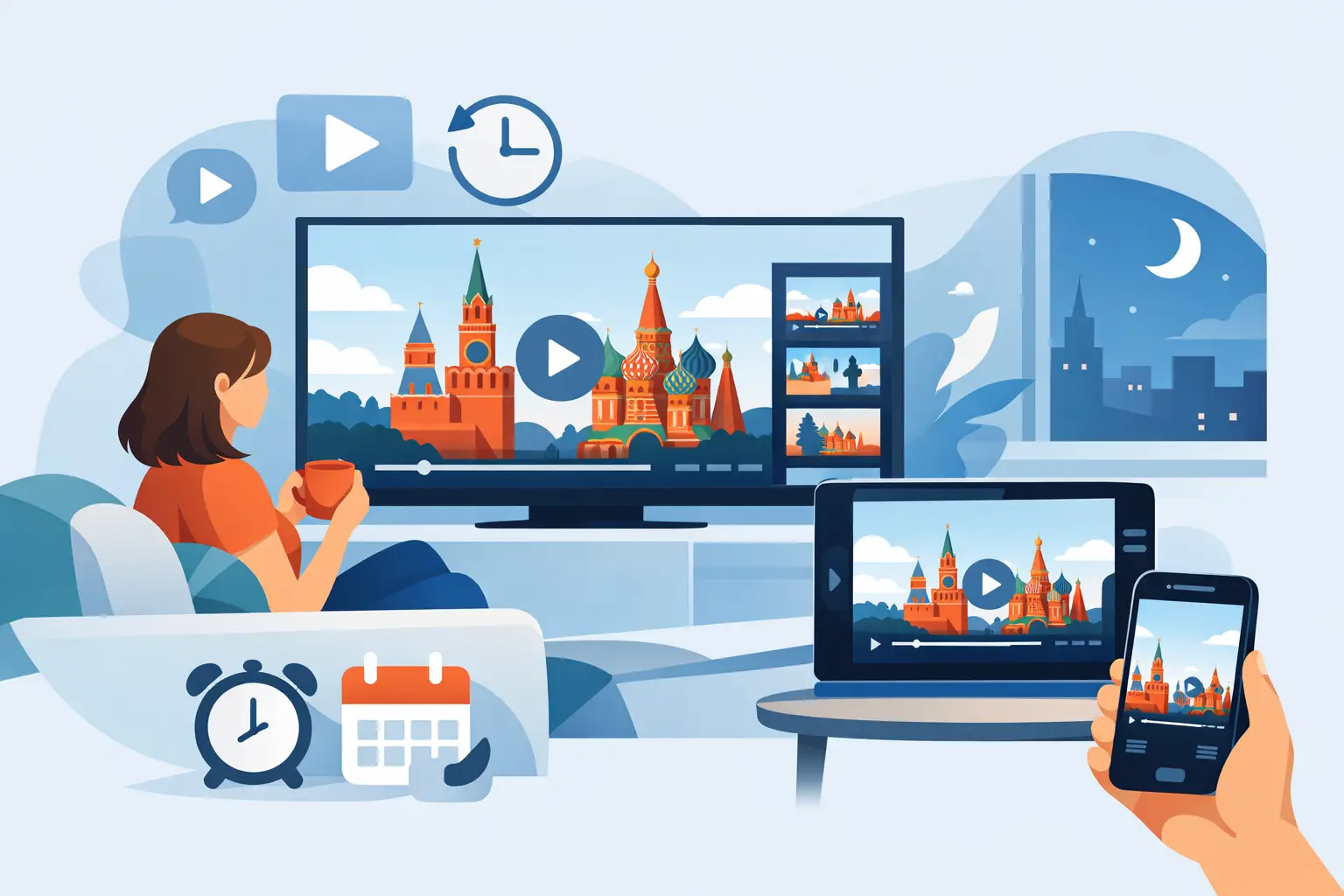
Missing a live broadcast used to mean waiting for a rerun or asking someone back home what happened. That is exactly why russian tv with catch up matters for viewers in the US. If your evening starts after Moscow prime time, or your family wants cartoons, news, and series at different hours, catch-up viewing gives you a practical way to watch Russian-language TV when it actually fits your day.
For many households, live TV is still important. You want breaking news, sports, holiday programming, concerts, and familiar channels playing in the background. But live schedules are not built around American time zones, work shifts, school pickups, or busy family routines. A service with channel archives and replay access solves that problem without forcing you to hunt for clips or piece together content from multiple apps.
What russian tv with catch up really means
In simple terms, catch-up TV lets you go back and watch programs that already aired on live channels. Instead of being tied to the broadcast hour, you can open the channel archive, find the program, and start it later. For Russian-speaking families abroad, that is often more useful than live-only TV because the content stays familiar while the schedule becomes flexible.
This matters even more when one subscription is used by different people in the same home. Parents may want evening talk shows and news. Kids may want cartoons on a tablet after school. Grandparents may prefer traditional channels and classic films on a larger screen. Catch-up features make that mix easier because no one has to build the entire day around one channel’s schedule.
The other benefit is continuity. If you miss the first half of a program, or if you start watching late, archive access can help you pick up what you missed. That sounds simple, but for everyday use it changes the experience from “I hope I catch it” to “I’ll watch it when I’m ready.”
Why catch-up matters more outside Russia
For viewers living in the US, time difference is the first issue. A program airing at a convenient hour in Russia may land in the middle of the workday or late at night in New York, Chicago, or Los Angeles. Without replay access, a strong channel lineup still leaves gaps in real use. With catch up, the same lineup becomes much more practical.
The second issue is convenience. Many Russian-speaking viewers abroad want one place for live channels, movies, series, kids’ content, and recent broadcasts. Switching between separate services can be frustrating, especially for families helping older relatives set things up. A single subscription that combines live TV and archived viewing keeps things simpler.
The third issue is consistency. People choose Russian-language television for connection – language, humor, music, news, traditions, and the everyday rhythm of familiar programming. If the service works only when you are free at the same moment as the broadcast, that connection becomes harder to maintain. Catch-up access keeps it available on your schedule.
What to look for in russian tv with catch up
Not every TV service offers the same level of replay access. Some have only a small archive. Others include catch-up on limited channels or make navigation harder than it should be. If you are comparing options, look beyond the phrase itself and focus on how usable the feature is.
A strong service should give you a large number of channels and make archived content easy to find. The archive should feel like a normal part of the viewing experience, not a hidden extra. If you have to fight through menus every time you want to replay something, the feature loses value quickly.
Device support matters just as much. Catch-up TV is most useful when it works across the screens you already use – Smart TV in the living room, smartphone in the kitchen, tablet for travel, and computer for quick access during the day. Good compatibility means you do not need to rebuild your setup just to watch one program later.
Picture quality also counts. Replay should not feel like a downgrade from live viewing. If a service offers HD, Full HD, 4K, or broader quality options, archived content becomes much more enjoyable for movies, concerts, sports, and family viewing.
The best setup is the one your household will actually use
A lot of people assume IPTV has to be technical. In reality, most viewers want a simple routine: choose a plan, open the app or player, sign in, and start watching. The value of catch-up TV drops fast if setup is confusing or limited to one type of device.
That is why broad compatibility is not just a feature list item. It is part of daily convenience. If one person watches on a Smart TV, another on a phone, and another on a TV box or tablet, the service has to support those habits without making each device a separate project.
For some users, a built-in app is the easiest option. For others, especially those already using IPTV software, support for m3u8-compatible players can be a real advantage. It gives flexibility without forcing everyone into the same method. The right choice depends on how comfortable you are with apps, players, and account setup, but the goal stays the same: watch quickly and without friction.
Live channels plus archives is better than live TV alone
The main reason viewers choose a subscription service over random online sources is reliability. You want stable access to Russian-language entertainment, news, series, documentaries, sports, and children’s programming in one place. A large channel catalog helps, but archives are what make that catalog usable in real life.
Think about how people actually watch. A parent may miss the start of a movie. A grandparent may want yesterday’s news discussion. A student may not have time until late evening. In each case, catch up turns a missed broadcast into a small delay instead of a lost program.
That is especially useful in family households. One person can follow live news while another returns to an earlier program. When the service also includes a film library and recorded content, the experience becomes closer to a complete entertainment package rather than just a stream of live channels.
Russia Plus TV is built around that practical model – broad channel choice, archived access, and support across common devices so viewers can watch familiar content in a way that fits everyday life.
A few trade-offs to keep in mind
Catch-up TV is valuable, but it is still worth knowing what varies from service to service. Not every channel may have the same archive window. Some types of programming may stay available longer than others. Sports, special events, and rights-managed content can sometimes work differently from standard entertainment channels.
There is also a difference between wanting maximum channel volume and wanting the simplest browsing experience. A very large catalog gives you more choice, but it helps if the interface is organized well enough for quick searching. Families usually care less about the biggest number on paper and more about finding the channels they actually watch without hassle.
Internet quality matters too. Even the best IPTV subscription depends on a stable connection, especially for HD and higher-resolution streams. If your home network is inconsistent, the right fix may be as simple as improving Wi-Fi placement or using a more stable device for the main TV.
Who benefits most from this kind of service
Russian TV with catch up is a strong fit for expatriates, immigrants, and Russian-speaking families who want native-language content available every day, not just on special occasions. It works well for homes with mixed viewing habits, for parents balancing different schedules, and for anyone who wants both live television and replay access in one subscription.
It is also a practical choice for viewers who do not want to chase content across multiple services. If your goal is straightforward access to channels, archives, films, series, and children’s programming on devices you already own, catch-up support is one of the features that makes the subscription feel worth it month after month.
The best service is not the one with the most complicated promises. It is the one that gives you reliable Russian-language TV, makes missed broadcasts easy to recover, and works on the screens your family already uses. When TV matches your schedule instead of fighting it, you get more out of every channel.