

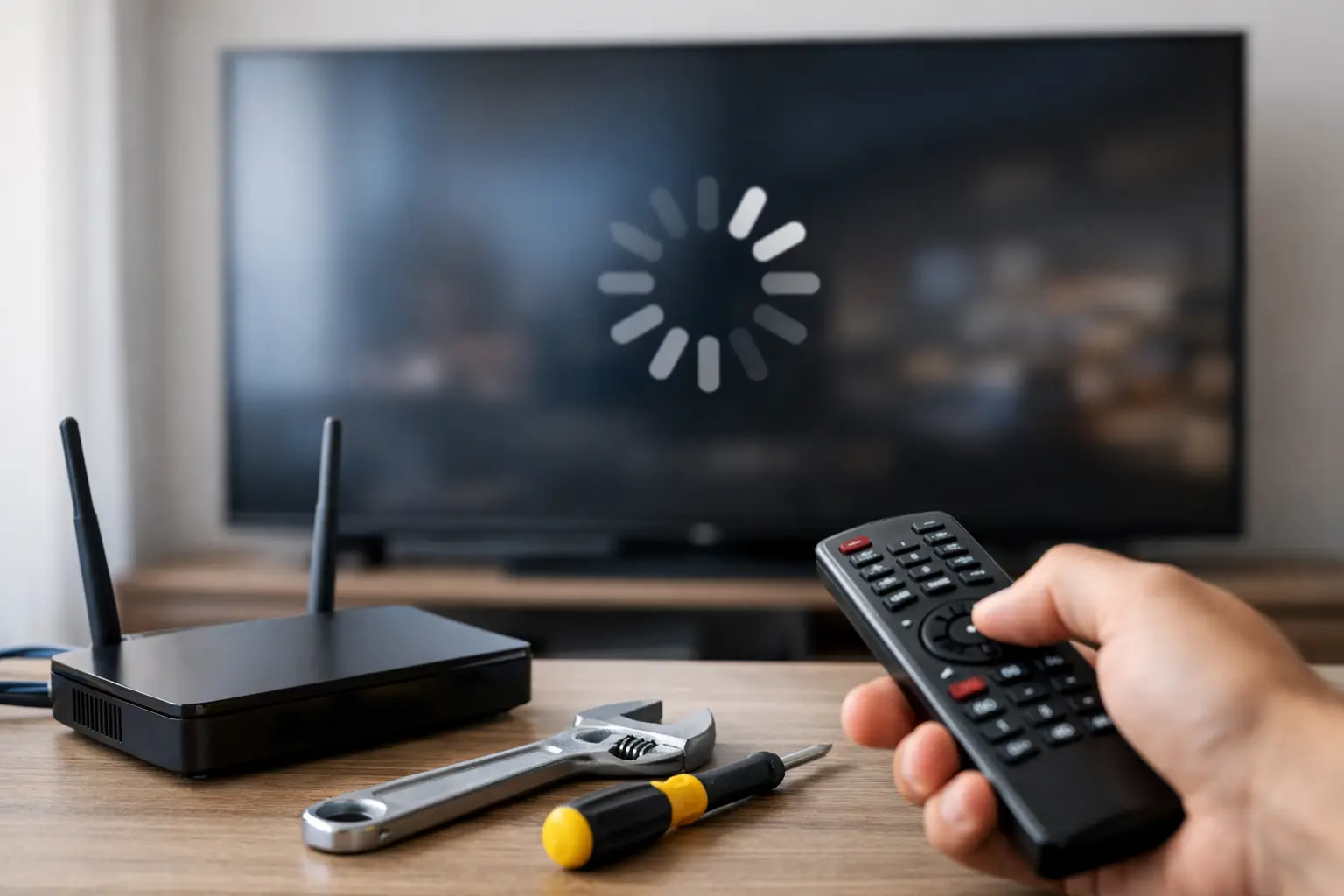
A live news program freezes just as the important story begins. A movie pauses every few minutes. If you are asking, “why is IPTV buffering,” the answer is usually not one single problem. Buffering happens when your device receives video data more slowly than it needs to play it. The good news is that most interruptions can be improved with a few practical checks at home.
For Russian-speaking families watching live channels, archives, films, sports, and children’s programming, reliable playback matters. Start with the simplest fixes first. They solve a large share of buffering issues without changing your subscription, buying expensive equipment, or spending hours in settings.
Why Is IPTV Buffering on Your Device?
IPTV sends television over your internet connection. Before a channel or movie appears on screen, your app or player temporarily stores a small amount of video data. This is called a buffer. If the incoming stream cannot keep up, playback stops briefly while the device loads more data.
A fast internet plan helps, but download speed is only part of the picture. Wi-Fi signal strength, network congestion, device performance, app settings, and the quality selected for a channel can all affect viewing. A connection that works well for web browsing may still struggle with a live Full HD or 4K stream.
Buffering can also look different depending on the content. If only one channel pauses, the issue may be specific to that stream. If every channel and on-demand title buffers, the cause is more likely your local network, device, or app.
Check Your Internet Speed and Stability First
Run a speed test on the same device and network you use for TV. Do not test from a phone sitting next to the router if your TV box is in another room. Results can be very different.
For one HD stream, a stable connection of about 10 Mbps is often sufficient. Full HD generally benefits from 15 Mbps or more, while 4K may require 25 Mbps or higher. These are practical starting points, not guarantees. Several people streaming, gaming, using video calls, or downloading files at the same time will share the available bandwidth.
Stability is just as valuable as speed. A plan advertised as 300 Mbps can still cause interruptions if the Wi-Fi signal drops, the router is overloaded, or the connection has frequent short outages. If buffering occurs mostly in the evening, your household may simply have more connected devices in use at that time.
Pause large downloads, cloud backups, game updates, and video calls for a few minutes, then test a channel again. If playback improves immediately, your network is likely being asked to do too much at once.
Use Ethernet When You Can
A wired Ethernet connection is usually the most dependable choice for a Smart TV or TV box. It avoids interference from walls, neighbors’ Wi-Fi networks, cordless devices, and distance from the router.
If running a cable is not practical, place the router in an open, central location rather than inside a cabinet or behind a television. For devices near the router, use the 5 GHz Wi-Fi band when available. It is often faster and less crowded than 2.4 GHz, although its range is shorter. In a larger home, a mesh Wi-Fi system may be more useful than simply upgrading to a higher-speed internet plan.
Restart the Equipment Before Changing Settings
A proper restart clears many temporary connection and memory issues. Turn off the streaming device or Smart TV, unplug the router and modem, wait about 30 seconds, and then reconnect them. Allow the internet equipment to fully come back online before opening your IPTV app.
This basic step is especially useful when playback was fine for weeks and suddenly starts buffering. Routers can slow down after long periods of continuous use, and older TV boxes can accumulate background processes that reduce available memory.
After restarting, open one channel and let it play for a few minutes. Avoid switching rapidly between many channels during the test. This makes it easier to see whether the interruption is resolved.
Match Video Quality to Your Connection
Higher picture quality uses more data. A 4K channel may look excellent on a large television, but it is not always the right choice for every network or device. If buffering is frequent, try an HD or Full HD version of the same content when available.
This is not a compromise you need to make forever. It is a useful test. If HD plays without interruption while 4K pauses repeatedly, your subscription is likely working correctly but your current network conditions are not sufficient for the larger stream. You may get better results by using Ethernet, reducing household traffic, or improving Wi-Fi coverage.
Also consider the screen you are watching. On a phone, tablet, or smaller bedroom TV, HD often provides a clear picture with less demand on your connection. Save 4K for the main screen when your network is quiet and stable.
Update Your IPTV App, Player, and Device
Outdated software can create playback problems, especially after a Smart TV, phone, or streaming platform receives a system update. Check for updates to your IPTV app or m3u8-compatible player, as well as updates for your TV box, television, phone, or tablet.
If you use a third-party player such as VLC, OTT Navigator, or Televizo, confirm that you are using the current version and that your playlist details were entered correctly. An old app version may handle video codecs, buffering, or network reconnection less efficiently than a current release.
On devices with limited storage, clear unnecessary apps and files. A nearly full device can become slow to open channels and may struggle with high-quality video. If your player offers a cache setting, increasing it slightly can help on an inconsistent connection. However, an excessively large cache may make channel changes slower, so use moderate adjustments and test one change at a time.
Look for Device-Specific Issues
A channel that works perfectly on a phone but buffers on a television points to the TV, box, or its network connection rather than the IPTV service. Try the same channel on a second device connected to the same home network. This simple comparison is one of the fastest ways to narrow down the cause.
Smart TVs are convenient, but some older models have less processing power and may no longer receive frequent app updates. In that situation, a dedicated TV box can offer faster navigation and more consistent playback. It also gives families an easy way to keep television viewing separate from phones and tablets.
If only one device has trouble, restart it, update its software, and test it closer to the router or with an Ethernet cable. If all devices buffer at the same time, focus on the router, household bandwidth, or internet provider connection.
When the Problem Is a Single Channel or Time Period
Not every playback issue has the same cause. A particular live channel can have a temporary upstream problem, while the rest of the catalog works normally. Check another live channel, then try an archived program or a film. If those play normally, wait a few minutes and return to the affected channel.
Live sports and major news events can also create unusually high demand across the internet. During those periods, even a normally reliable home Wi-Fi setup may need help. A wired connection, fewer active devices, and a lower video quality setting can make a noticeable difference.
If the issue continues after testing multiple channels, devices, and a router restart, collect a few useful details before contacting support: the device model, app or player name, channel name, approximate time, and whether the issue affects live TV, archives, or both. Clear information helps support identify the right next step faster.
A Better IPTV Setup for Everyday Viewing
The most reliable arrangement is straightforward: a current app or player, a capable Smart TV or TV box, stable home internet, and Ethernet where possible. Russia Plus TV is designed for viewing across televisions, boxes, computers, phones, and tablets, so you can test another compatible device when one screen is not performing as expected.
Small improvements add up. Move a weak Wi-Fi device closer to the router, reserve 4K for the strongest connection, restart equipment occasionally, and keep apps updated. That leaves more time for familiar channels, family movies, cartoons, series, and recorded programs – without watching a loading circle instead of the show you chose.












1 comment
[…] than an HD stream. If your connection is fast but unstable, the picture may pause, reduce quality, or buffer at the worst moment. In that situation, dependable Full HD is more enjoyable than 4K that keeps […]